
03 · NEX
Behavioral Profile: the trading habits you can't see
ProYour trading behavioral profile from 30+ trades: what works, what costs you, bias scores and changes to test. Refreshed weekly on Ultimate, monthly on Pro.
A trading behavioral profile is a one-page read of how you trade. In Limbix, NEX writes it from your last 30 or more trades: what is working, what is costing you, how strongly common biases show up, and changes worth testing. It refreshes weekly on Ultimate and monthly on Pro, so you can track whether you improve.
How your trading behavioral profile is built#
Open Behavioral Profile in the sidebar.
Unlocking your first profile#
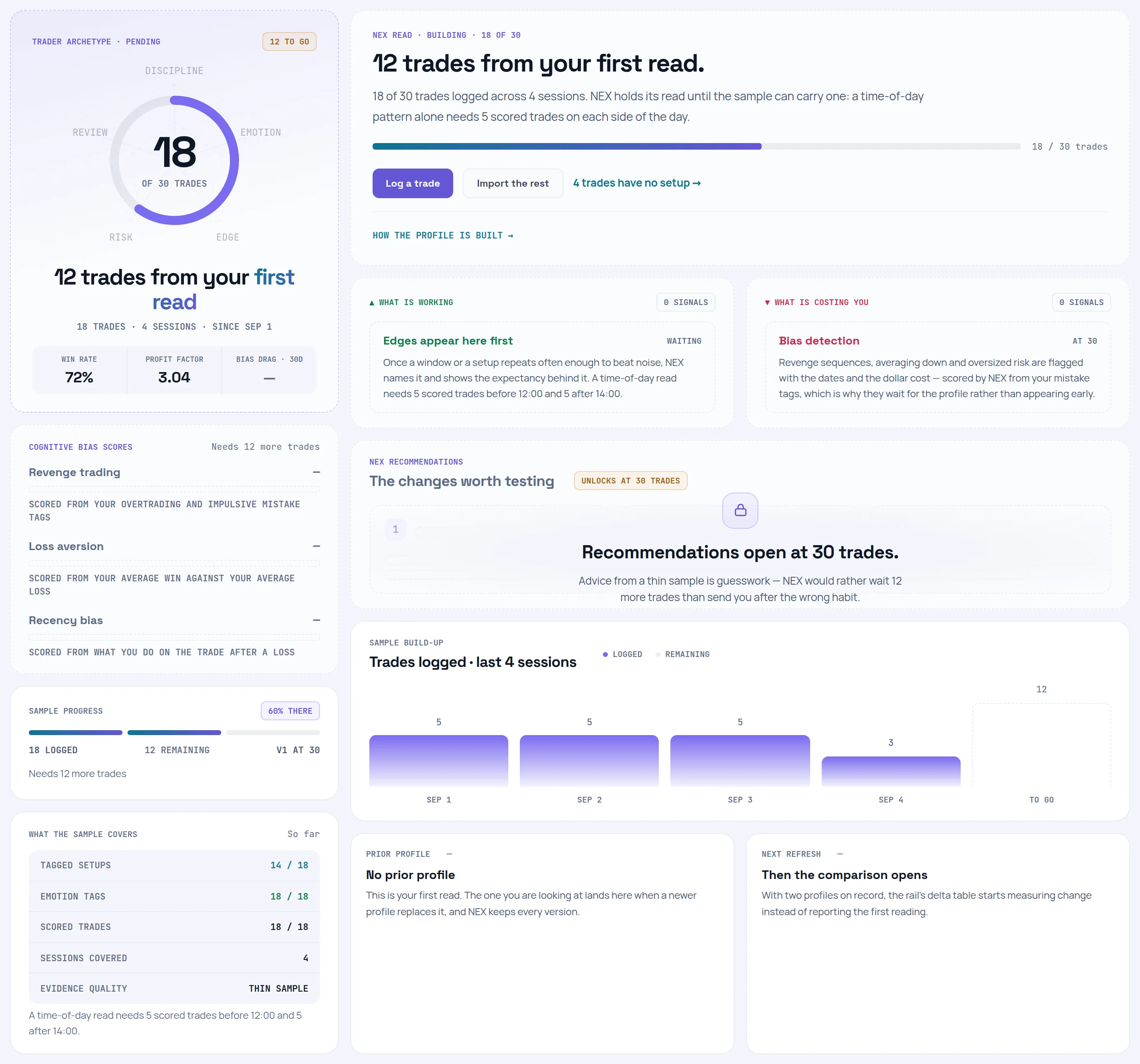
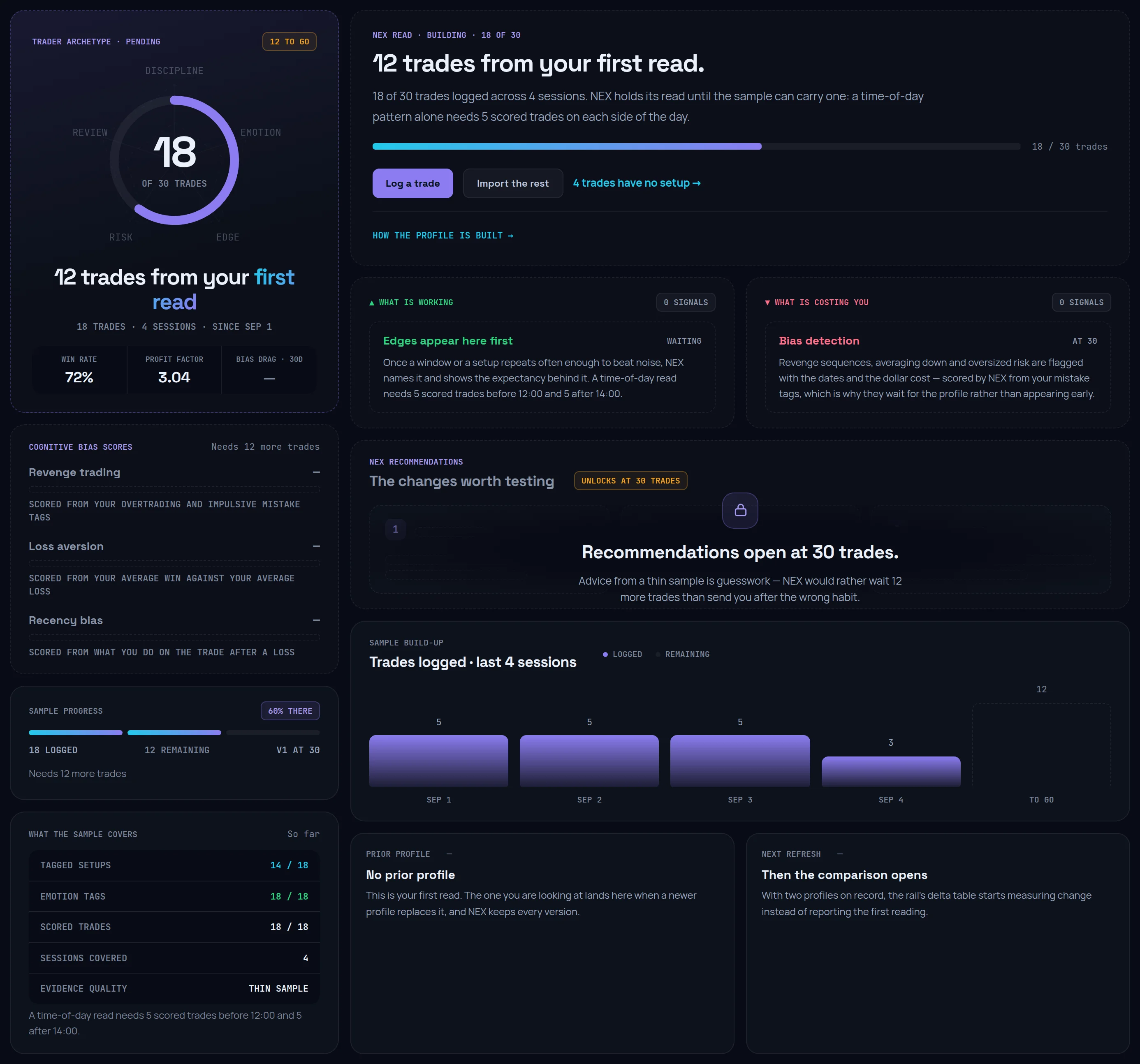
The profile needs 30 trades before NEX will write one. With no trades yet, the page shows Three steps to your first read: log or import trades, tag setups and mistakes, then generate profile V1. From your first trade on, it counts down instead: the headline tells you how many trades are left, a progress bar counts Trades logged toward your first profile, and Log a trade and Import the rest take you to the fastest way to close the gap. Recommendations stay locked until 30 trades, because advice from a thin sample is guesswork.
Tags matter more than volume. They are what separate a bad setup from a bad decision, and every bias score is computed from them. See tag emotions and mistakes on a trade.
Once you have the sample, press Generate profile. The profile is written in the background and appears on the page when it is ready.
Refresh cadence#
| Plan | New profile available |
|---|---|
| Ultimate | Weekly after the last one |
| Pro | Monthly after the last one |
| Essential | Not included |
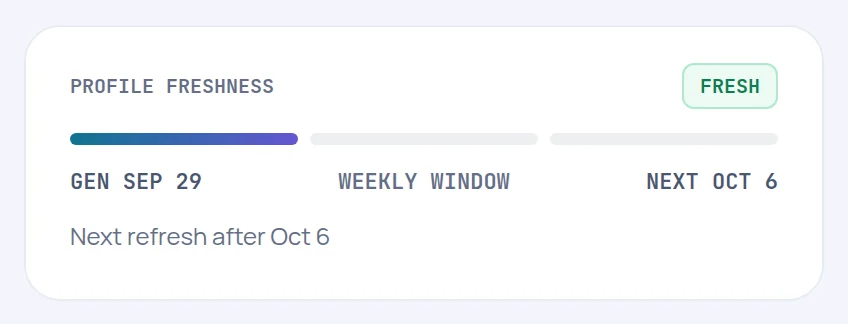
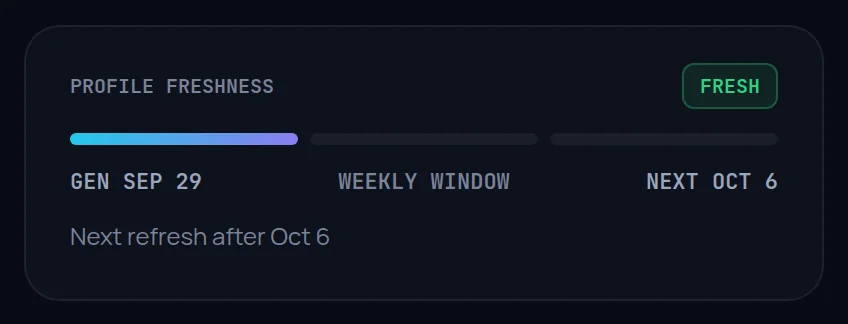
When a refresh is due, Refresh profile runs it. Before then the button reads "Next refresh after" a date, and Settings › NEX shows Next refresh available. The weekly refresh job also queues a new profile for eligible accounts when the window has passed. That automatic refresh doesn't use your monthly NEX allowance: only clicking Refresh profile does.
What's on the profile#
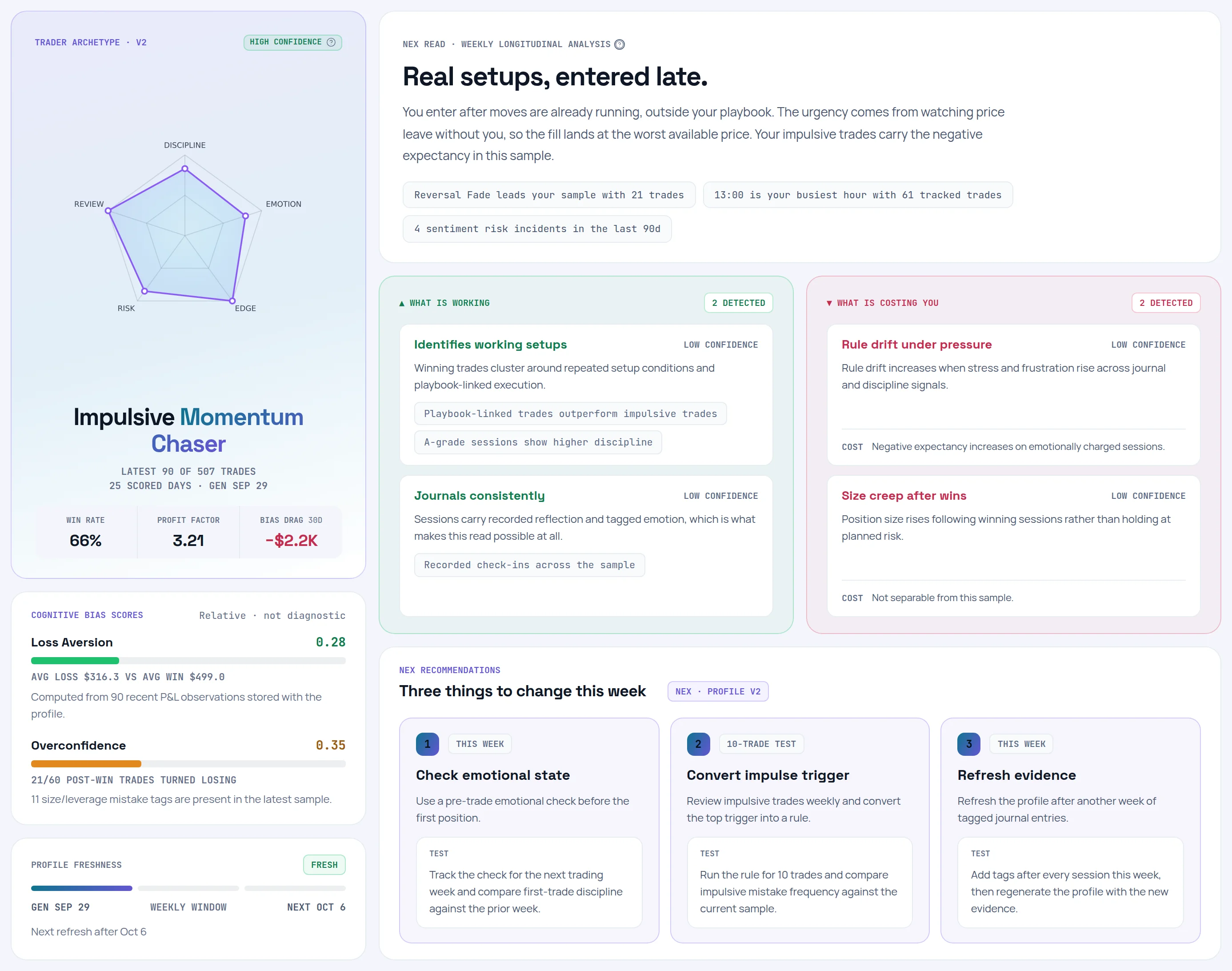
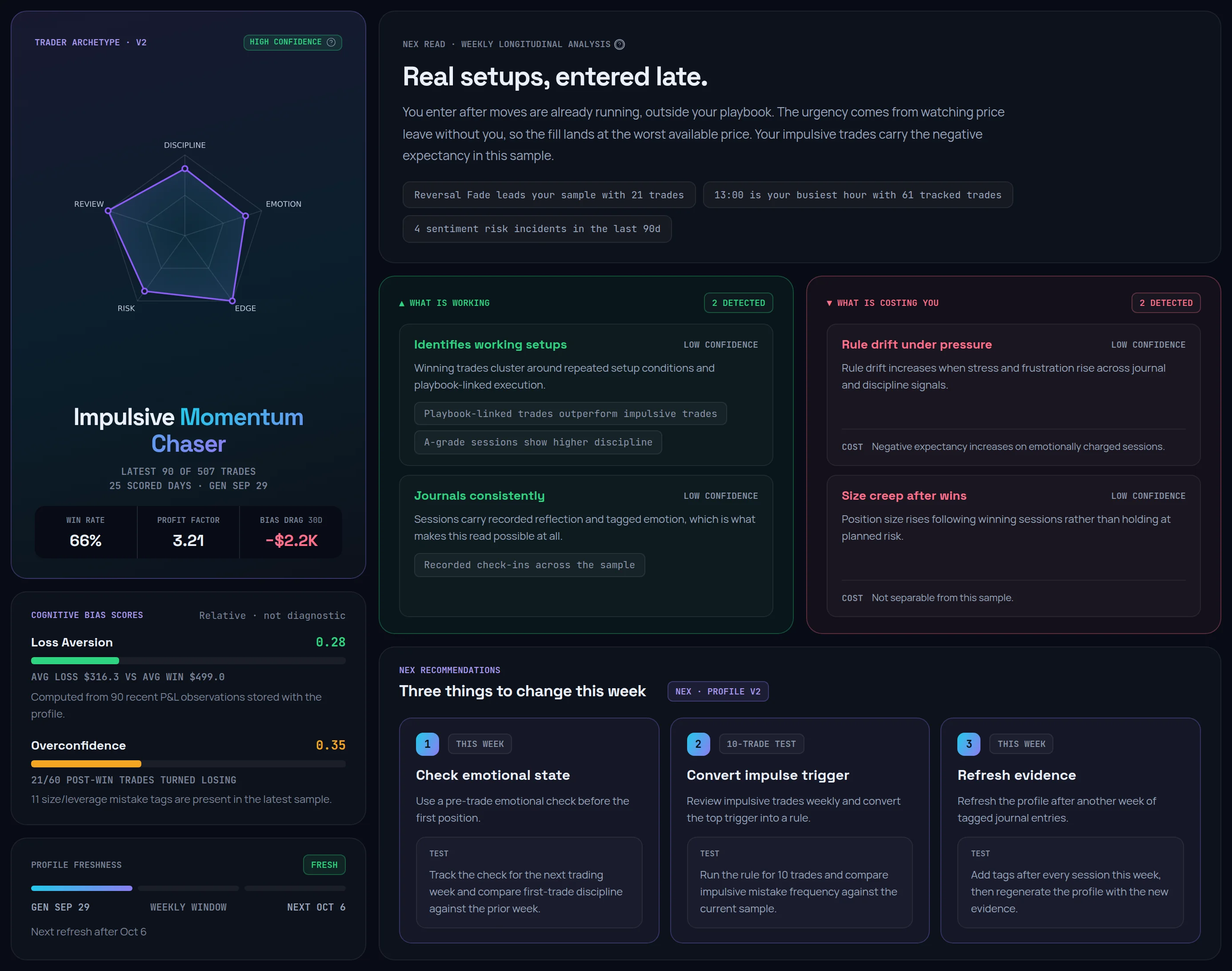
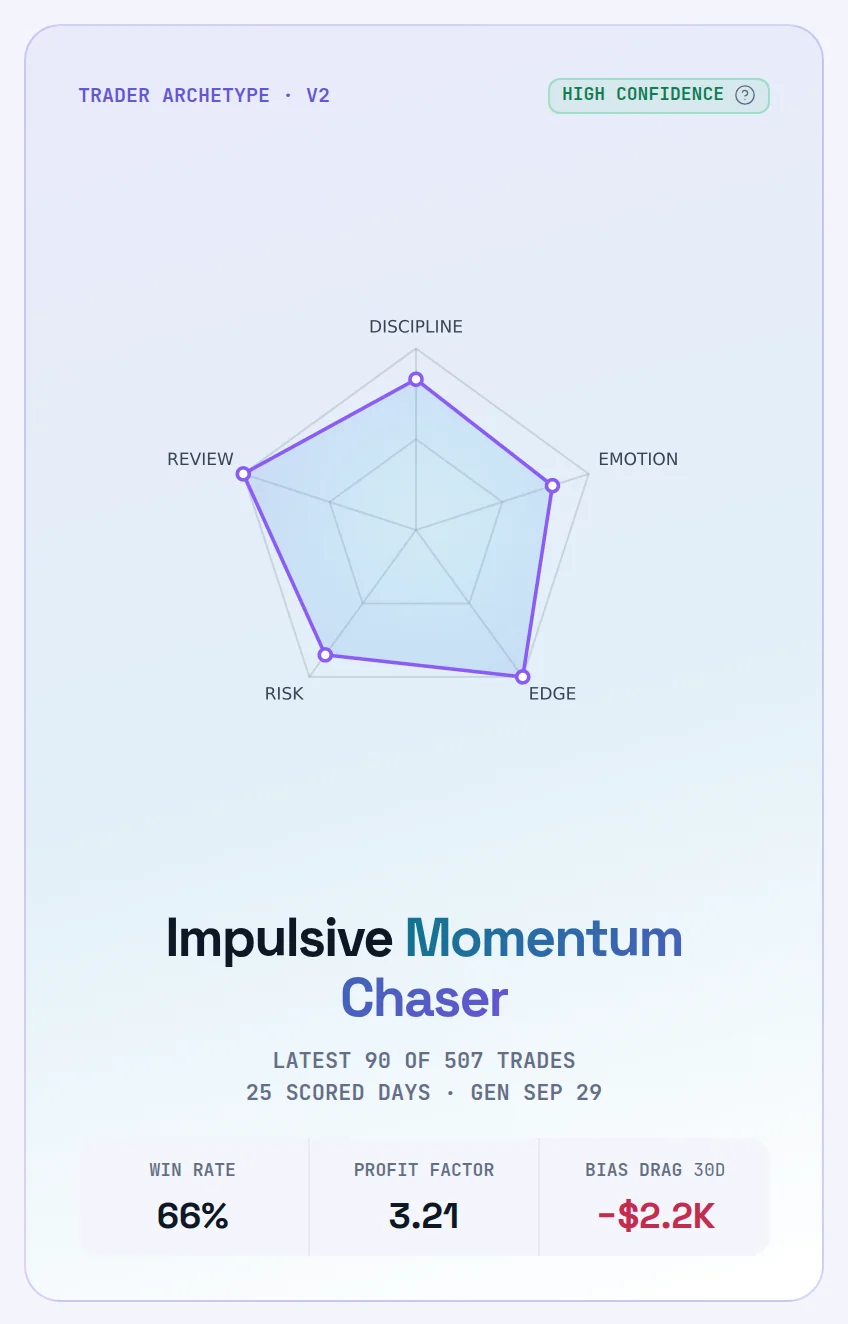
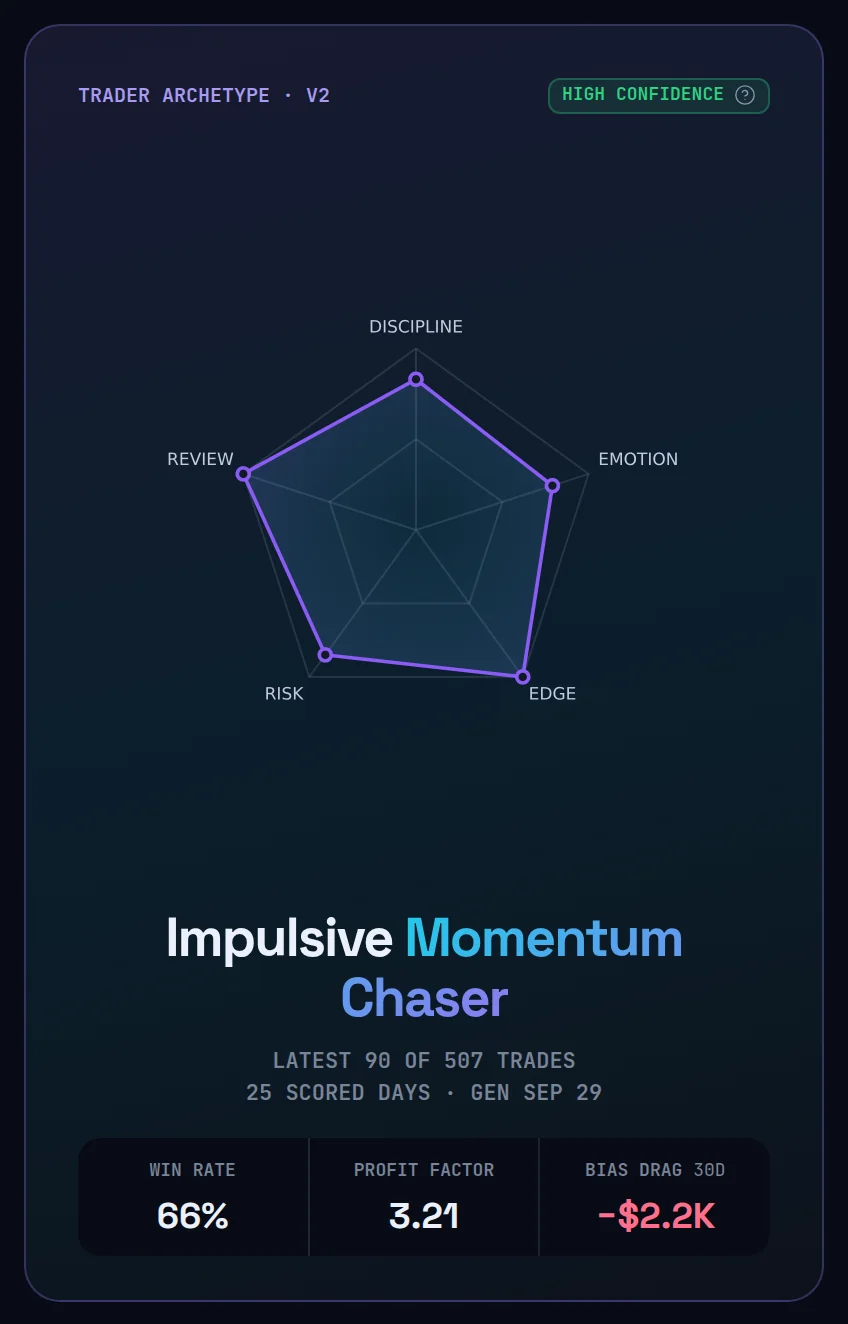
Archetype. NEX's name for your overall pattern, written from your evidence. Under it: the sample it was read from, your win rate, your profit factor and your bias drag over the last 30 days (what losing trades carrying a mistake, a broken rule or a negative emotion cost you). The chip in the corner is how much evidence the read rests on.
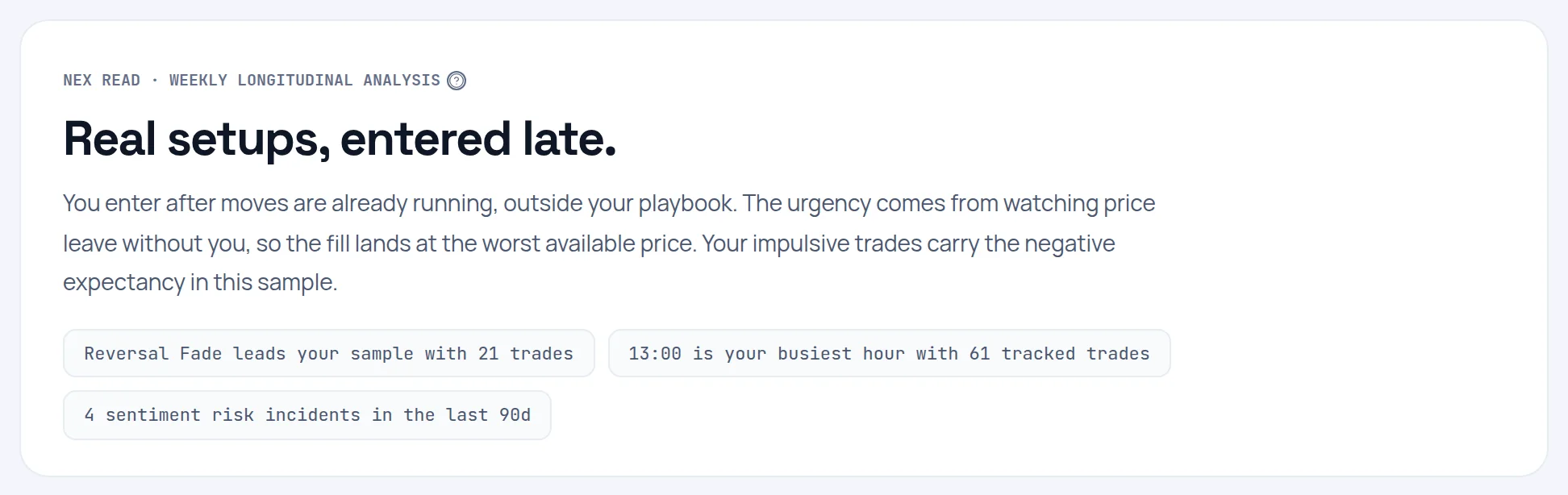
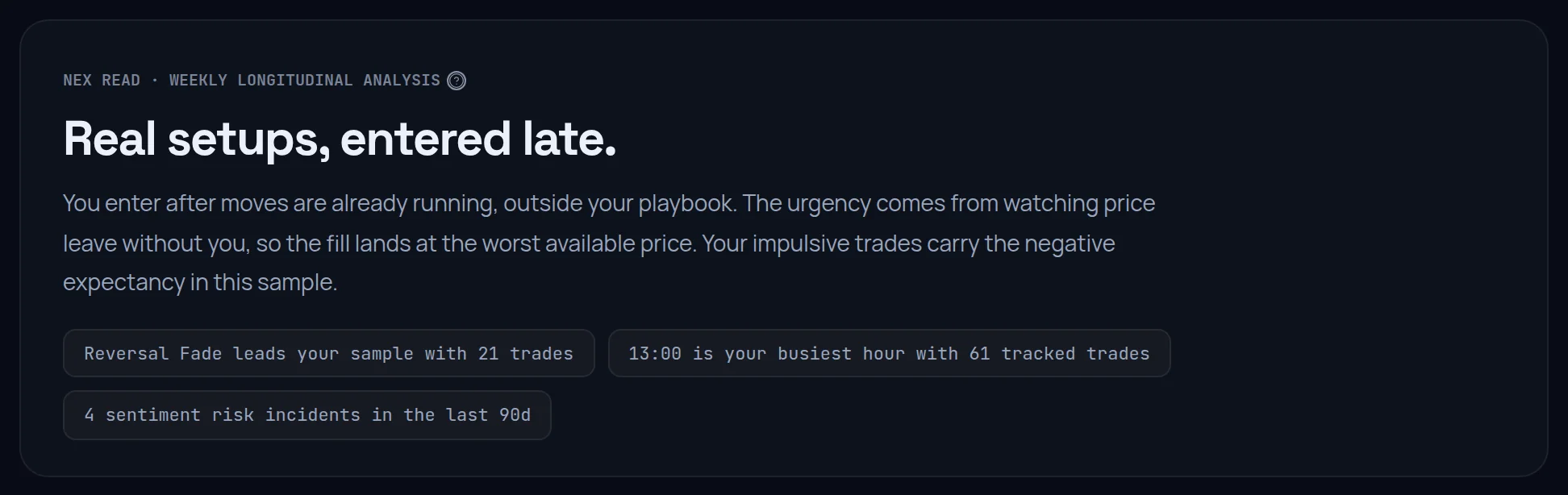
NEX read. One headline and a short paragraph on the pattern, with the facts it rests on as chips underneath: your most-used setup, your busiest hour, risk incidents in your journal.
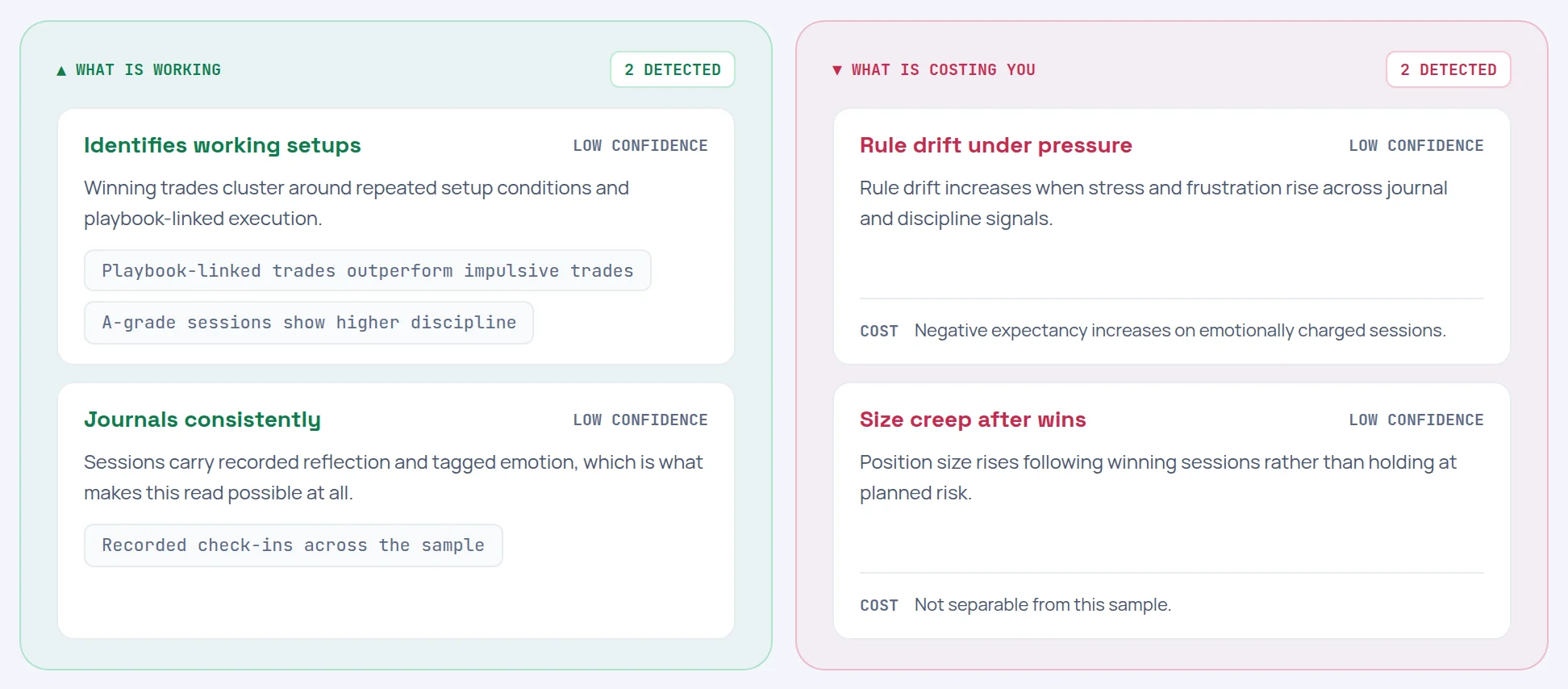
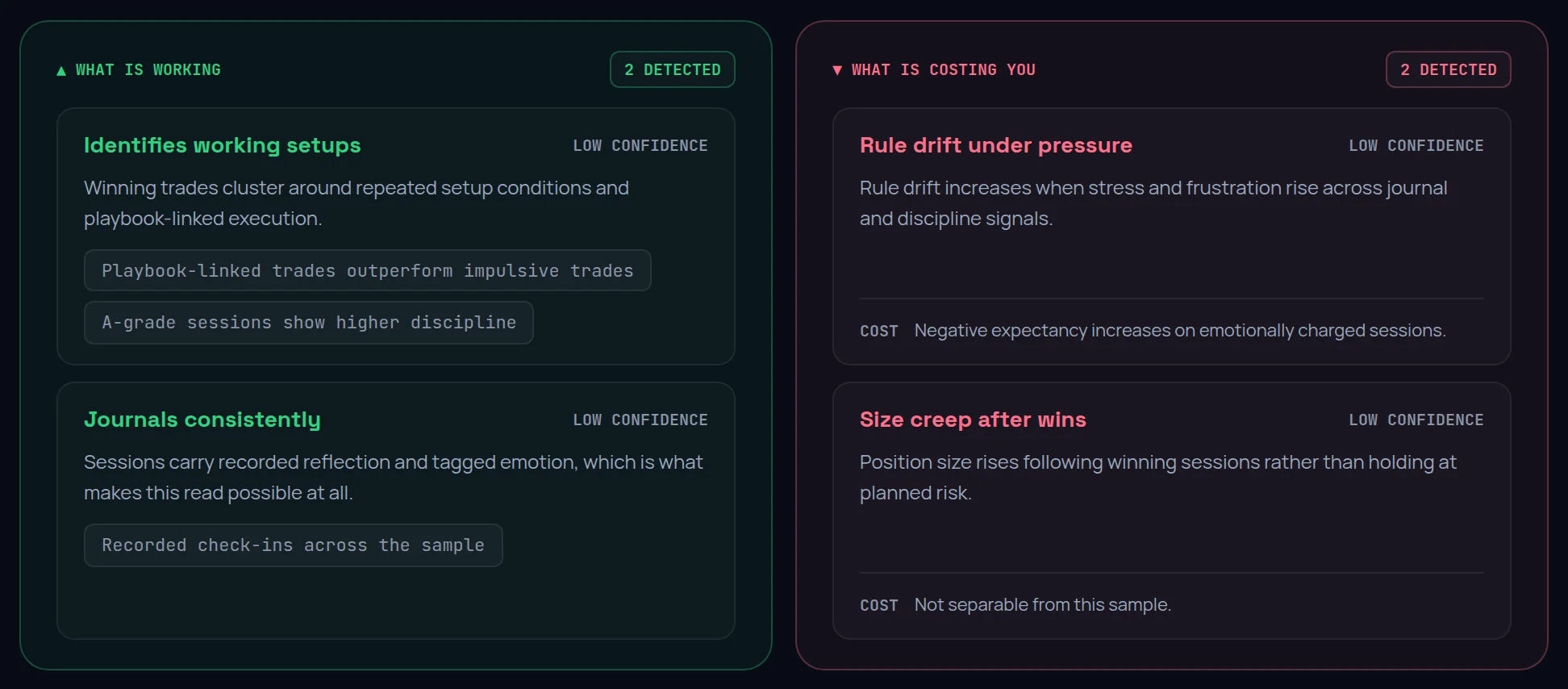
What is working and What is costing you. At least two of each, every one with the evidence behind it and its own confidence. Costs carry their P&L impact, or say plainly when it can't be separated from the sample.
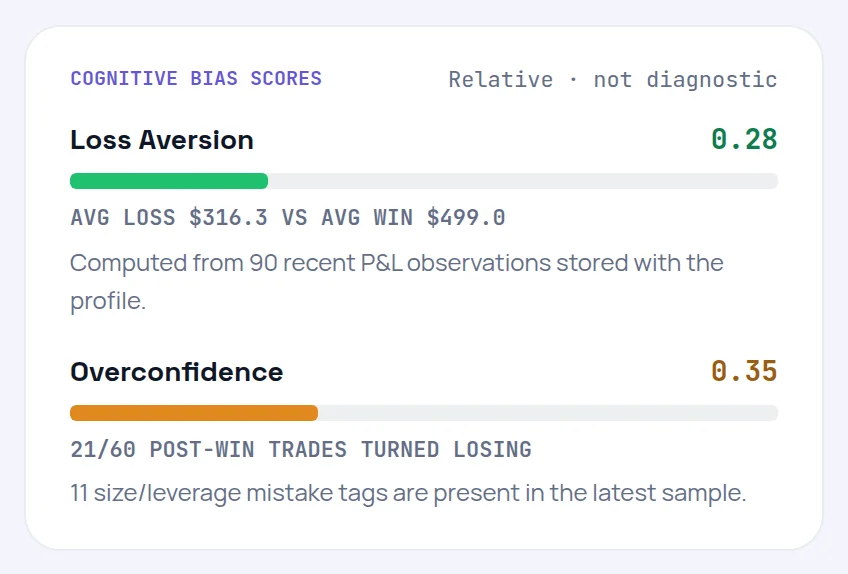
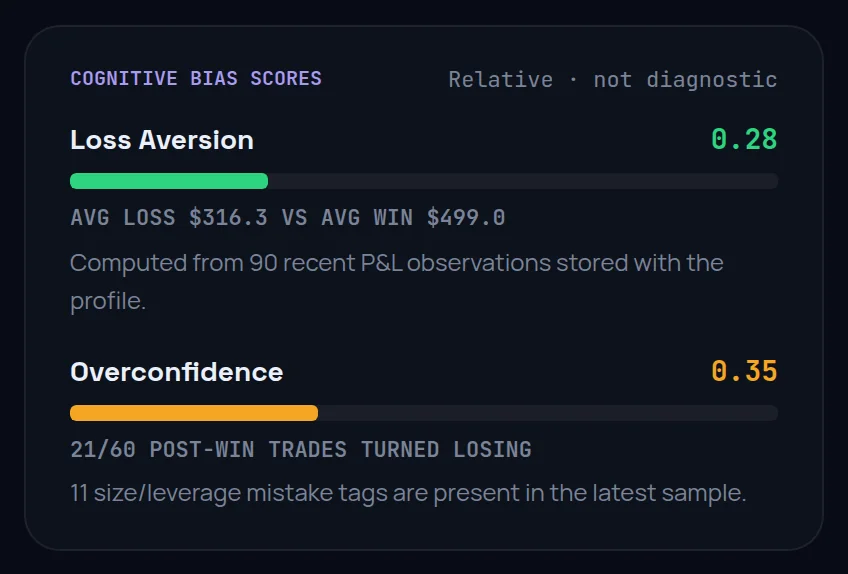
Cognitive bias scores. How strongly biases such as loss aversion, recency bias and revenge trading show in your record, each scored 0 to 1 with a bar and the numbers it was computed from. The card says it plainly: Relative · not diagnostic.
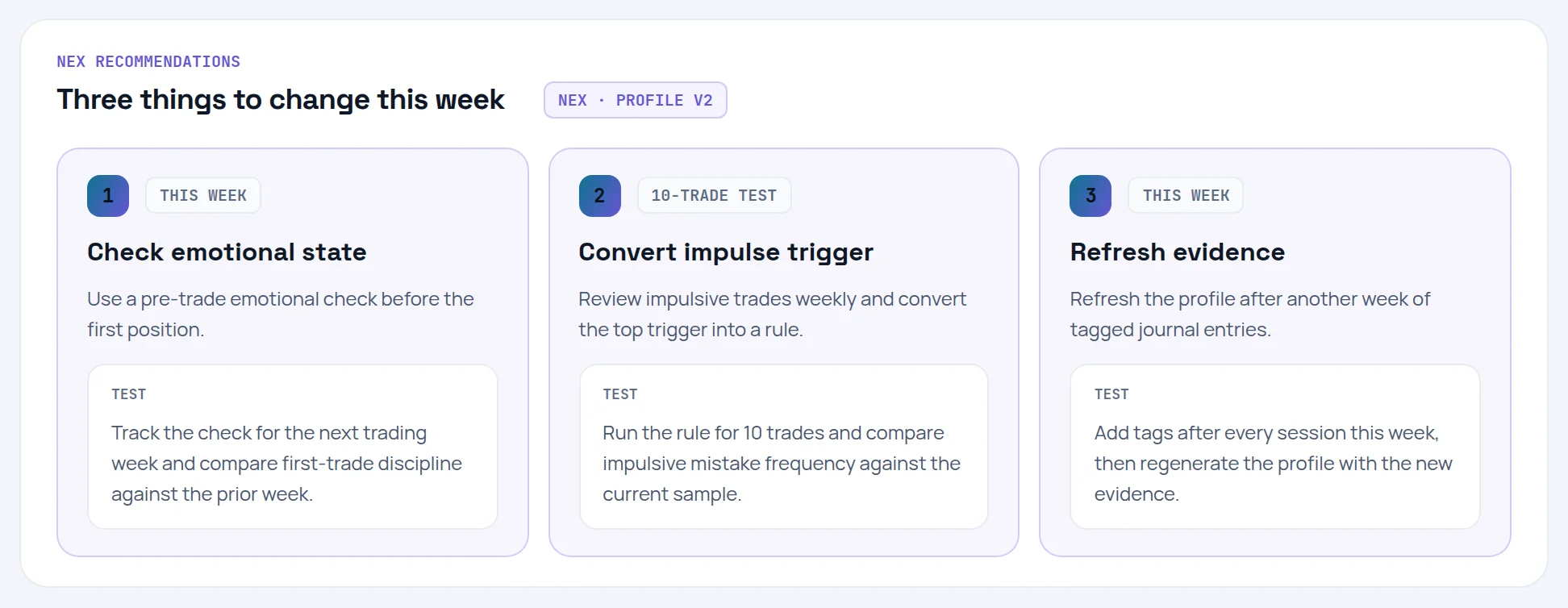
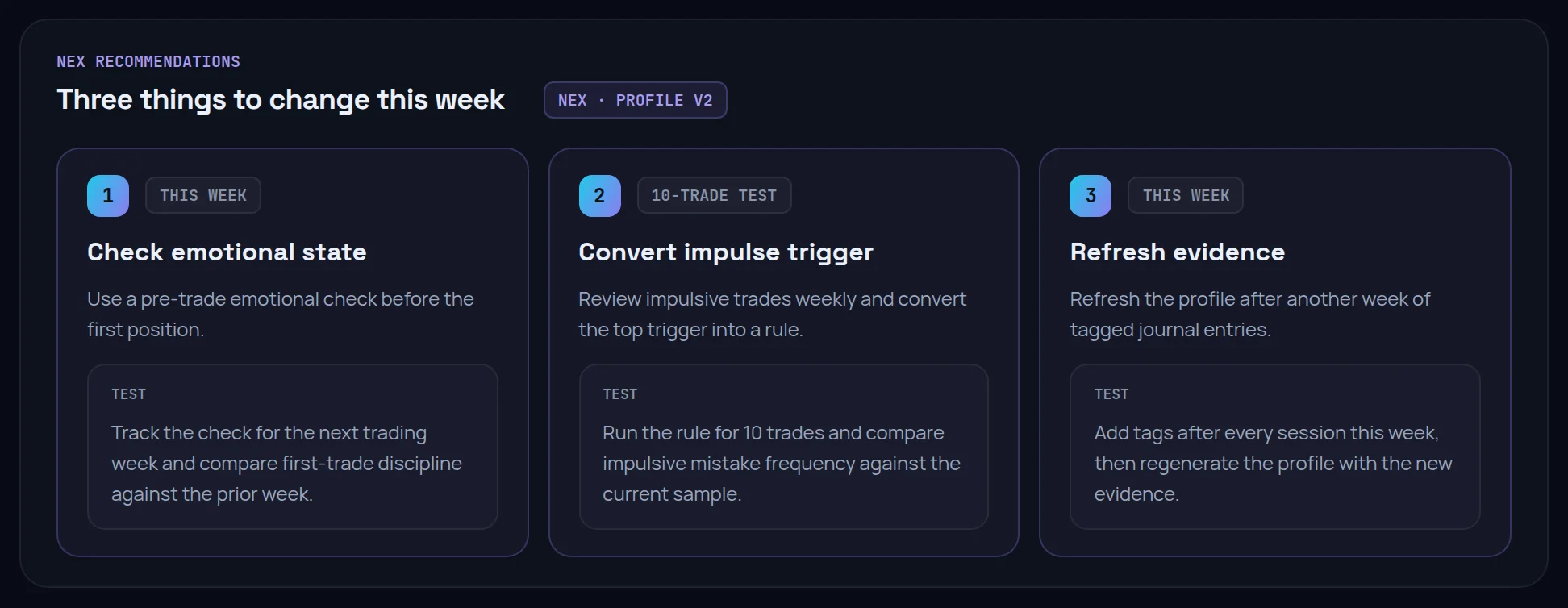
NEX recommendations. Changes to test in your execution. Each has a short title, the evidence, a Test you can measure, and a time horizon. They are about your process, never about a market.
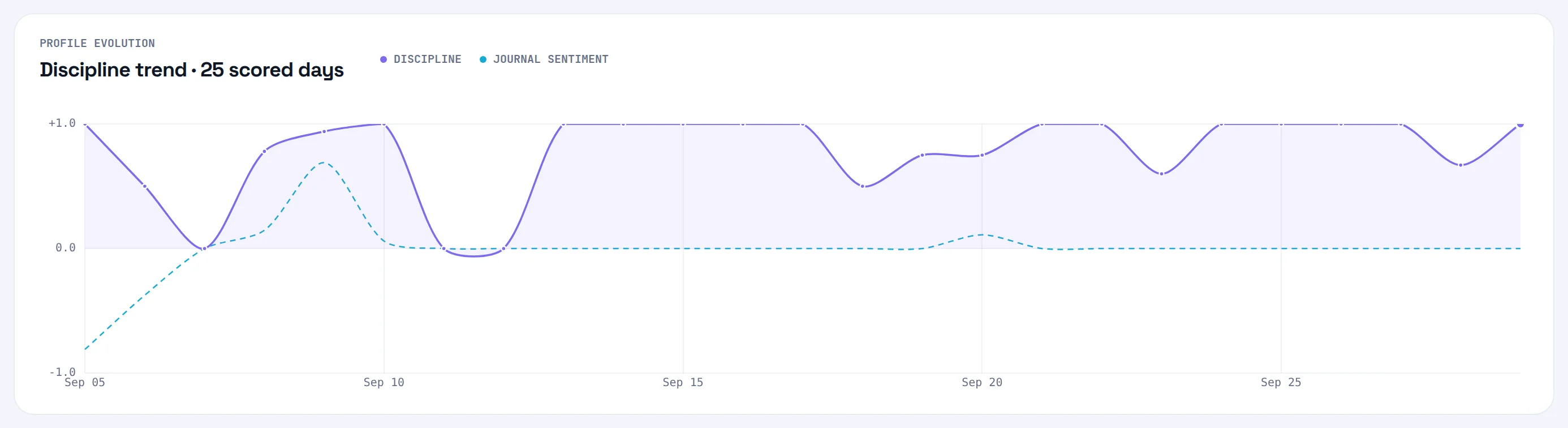
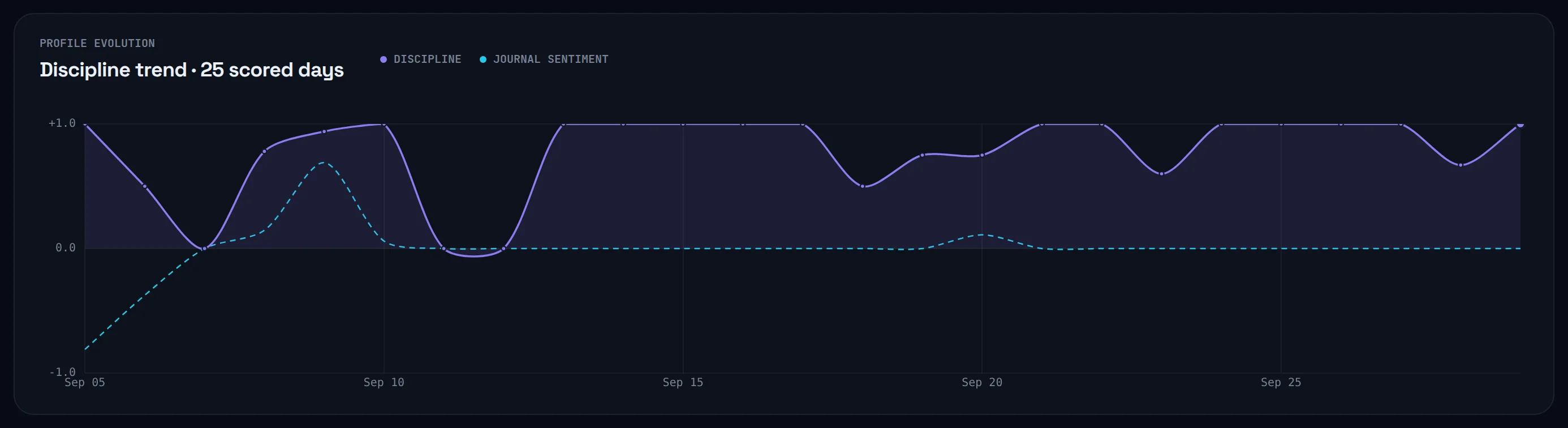
Profile evolution. Your discipline and journal sentiment for each scored day in the sample, so a single bad week stands out from a trend.
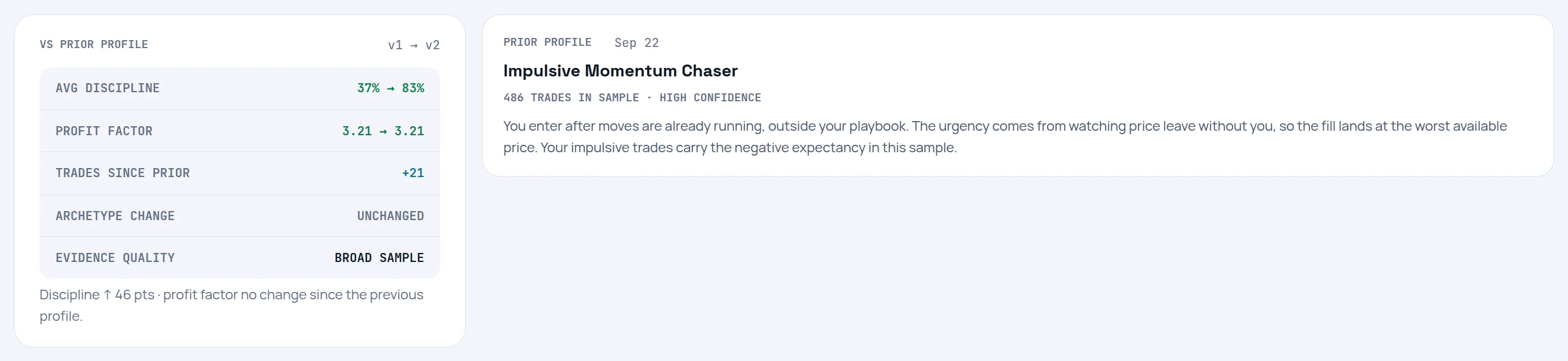
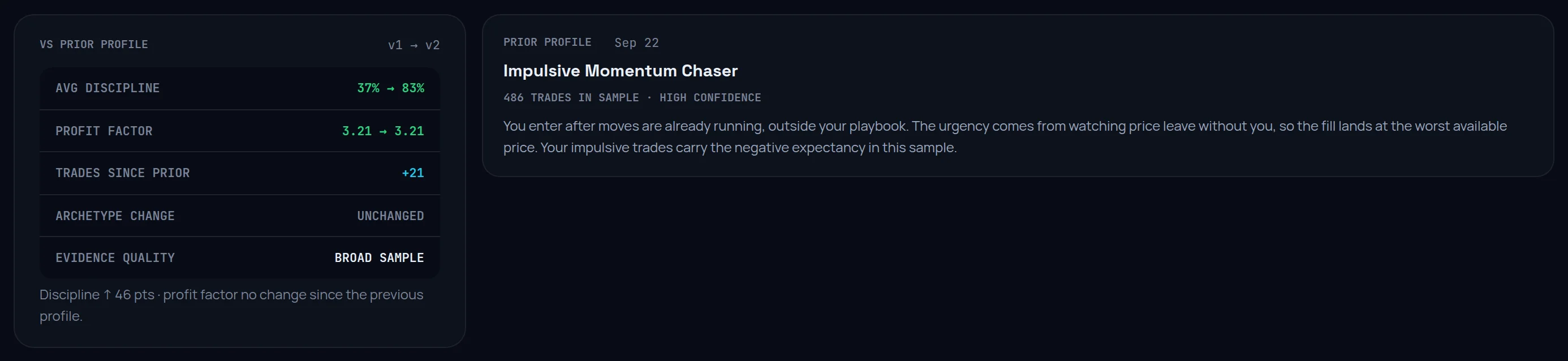
Vs prior profile. Once you have two profiles: archetype change, trades since the last profile, average discipline, profit factor and evidence quality, with the previous profile beside the table.
Two labels keep the page honest. Derived from aggregates marks a line Limbix wrote from your totals because NEX did not isolate a finding. Estimated · NEX offline marks a profile written while the AI provider was unavailable.
Confidence and evidence#
Each finding is rated High, Medium or Low confidence from the evidence behind that finding, not your total trade count. A 400-trade profile can still hold a read resting on four post-loss trades, and that read is labelled Low. Below the medium threshold a finding is directional only, and the page says so.
Risk patterns and what Limbix tells each one#
Limbix tests its Risk Score against eight reference traders whose behavior is known by construction. They are useful for reading your own numbers: find the pattern closest to yours and you know which component will drop and what sentence you'll see.
| Pattern | Behavior | What drops | What Limbix tells you |
|---|---|---|---|
| The Institutional Pro | Flat risk, stops that hold, inside every limit | Nothing. The Risk Score lands in Controlled and doesn't cap discipline. | That all 20 trades were sized close to your typical €100. |
| The Gambler | Small risk almost every time, a few trades at many times the usual size | Risk Consistency | That 2 of 20 trades risked well above your typical €250. With a large enough sample, it adds a ceiling to keep each trade under. |
| The Stop Mover | Declares stops, but half the losers run to −2R or worse | Loss Containment | "5 of 10 losses ran past your stop. They cost 6.7R more than planned." |
| The Overtrader | Keeps trading after the daily loss limit on half the days | Exposure Discipline | "You kept trading after hitting your daily loss limit on 6 of 12 days." |
| The Rule Breaker | Takes playbook trades below the playbook's minimum R:R | Risk Rule Adherence | "Minimum R:R was breached on 16 of 20 checks." |
| The No-Stop Journaler | Logs faithfully, never records a stop | Nothing is scored: the Risk Score shows "—" and discipline is unchanged | The Risk Score reads "Not enough recent trades to measure — needs about 8 in the last 30 days.", because no trade has a risk amount. The Loss containment row adds "Recent trades have no stop recorded, so risk can't be sized — needs 5 losses that had a real stop." |
| The Blank Slate | No trades yet | Everything shows "—", never 0 | The empty-window explanation for the trailing 30 days |
| One broken dimension | Three strong components, one broken | The weakest component anchors the score | See the example below |
R is your result in units of the risk you planned: a loss of −2R is twice what your stop allowed. The figures here are this reference data; yours will carry your own counts.
One broken dimension, worked through. Say your stops hold, you respect your daily limits and you keep your playbook risk rules: three components in the 90s. But your sizing is erratic, so Risk Consistency is weak. Averaged, the four parts would land in Loose. One very weak part pulls the whole score down, though, so your Risk Score lands in Fragile. That band's cap can then hold your Discipline Score below your Rule Compliance. Three good habits don't average away one broken one.
What NEX reads#
The profile is written from a summary of your record, with IDs removed:
- trade count, win rate, profit factor, average R and max drawdown (in currency);
- your Discipline Score over the sample, recent rule breaks and impulsive trades;
- performance by playbook, by hour of the day and by day of the week;
- your 25 most recent trades, with emotion, playbook, rule breaks and mistakes;
- recent journal sentiment, notebook themes and check-ins;
- your previous profiles, so it can say what changed.
Journal tone comes from Sentiment Analysis. Settings says switching sentiment analysis off breaks behavioral profiles. It doesn't: your profile still generates and keeps reading the sentiment reads made before you switched off. No new ones are added, so its read of your tone stops updating.
What NEX won't do#
- Diagnose you. Bias scores are relative to your own record. No clinical labels.
- Tell you what to trade. Every change it lists is about your execution: waiting for the setup, sizing to your own rule, holding the stop.
- Pass off totals as findings. Anything NEX didn't find itself is marked Derived from aggregates.
- Write a profile below the sample. Under 30 trades there is no profile, only the warm-up page.
Prompts to try#
What are my costliest mistakes over the last 30 days?
Explain my Discipline Score for this month.
Draft my monthly self-review
In the NEX Journal, NEX already reads your latest profile, so you can ask about it directly.
Actions and confirmations#
Generating or refreshing a profile is the only action here, and pressing the button is the confirmation. The profile writes nothing to your trades. To act on a finding, ask NEX in the NEX Journal to set tomorrow's focus or add a watch item; it proposes the change and you apply it. See Actions and confirmations.
Limits#
- Each manual Generate profile or Refresh profile uses one NEX interaction.
- A profile older than about five weeks is passed to NEX marked as possibly outdated.
Frequently asked questions#
How many trades do I need for a behavioral profile?#
Thirty. Below that, the page shows how many trades you still need and the early reads building up. The sample is only as useful as your tags: emotion and mistake tags are the evidence every bias score is computed from. A profile on 30 untagged trades says much less than one on 30 tagged ones, and its findings are labelled with lower confidence.
How often does my behavioral profile update?#
On Ultimate, a new profile is available one week after the last. On Pro, one month after. When a refresh is due you can run it with Refresh profile, and a weekly job also queues one for eligible accounts. Each profile is compared with the one before it, so the page shows what changed: archetype, discipline, profit factor and evidence quality.
What is a trading bias score?#
A bias score rates how strongly a known trading bias shows up in your record, such as loss aversion, recency bias or revenge trading. Limbix scores each from 0 to 1, relative to your own data, with a bar, the evidence it was computed from and an explanation. A thin sample adds "low confidence" to the evidence line. They are coaching cues, not a diagnosis. The page labels them Relative · not diagnostic.
Is my profile archetype the same as the risk patterns on this page?#
No. The archetype is NEX's own description of your overall pattern, written from your evidence. The eight risk patterns are fixed reference traders Limbix uses to test its Risk Score. They help you read your risk components: if you recognise yourself in The Stop Mover, expect Loss Containment to be your weakest component.
Does the behavioral profile give trading advice?#
No. The profile describes your past trades and suggests changes to test in your own execution, such as a rule to hold your stop for the next ten trades, each with a way to measure it. It holds no view on any market and never names an entry, exit or position size. Limbix is a journaling and analytics tool, and nothing in it is financial advice.