
04 · Metrics
Risk Score
The Risk Score rates how survivable your trading is from four things you controlled: sizing, stops, daily limits and playbook risk rules. Method, gates, bands.
How survivable your trading is, from four things you controlled at the moment of each trade — never from whether they won. Always the trailing 30 days. It caps discipline; it can never raise it. The Limbix risk score blends four components and then anchors to the weakest one.
How it's calculated#
The Risk Score is built from four components, each scored 0 to 100 over the last 30 days:
| Component | The question it answers |
|---|---|
| Risk Consistency | Does every trade risk about the same amount? |
| Loss Containment | When you were wrong, did the loss stop at your stop? |
| Exposure Discipline | Did you stop when you said you would? |
| Risk Rule Adherence | Did each trade obey its own playbook's risk rules? |
Risk Consistency and Loss Containment carry most of the weight. Exposure Discipline and Risk Rule Adherence carry the rest. The parts combine in three steps:
- Enough of the picture. Limbix first checks that enough of the four components could be measured. If too little is measured, the score is "—". A risk score built on one thin dimension would be a different measurement wearing the same name.
- A weighted blend of what was measured. A component that can't be measured yet is left out, never counted as zero. The components that were measured share its weight.
- The weakest part pulls the whole score down. One very weak component holds the score close to it, however strong the others are. Three strong dimensions can't average away one broken one.
The result is rounded once, at the end.
One exception to step 3. Exposure Discipline uses two checks: your daily loss limit and your trade cap. If you set only one of them, the component still counts at full weight in the blend. It just can't be the weak part that pulls the whole score down. That pull is a veto over the whole score, and a veto based on half the evidence would let one number typed during onboarding decide your band.
The window is fixed. The Risk Score always covers the last 30 days, whatever period you pick on the Discipline & Risk page. The components need volume, and risk is a standing condition, not an activity log. A quiet, clean week shouldn't reset it.
Every score is stamped. The exact weights and tolerances are part of Limbix's method version provisional-2026-09.4; they'll be published here once the method is validated. Each stored score carries that version, so a retune can never be mistaken for a change in your trading. Changes are listed in the changelog.
What moves your score#
| Action | Effect on your Risk Score |
|---|---|
| Keep every trade near your typical risk | Lifts Risk Consistency, one of the two heaviest parts |
| Size one trade far above your usual | Costs Consistency points, more the bigger it is |
| Let a loss run past your stop | Lowers Loss Containment, the other heavy part |
| Record a real stop on every trade | Lets Loss Containment be measured at all |
| Open a trade after your daily loss limit was hit | Fails that day in Exposure Discipline |
| Set a daily loss limit and a trade cap | Brings Exposure Discipline into the score |
| Break a playbook's risk rule | Lowers Risk Rule Adherence |
| Fix the component marked Weakest | Moves the score most, because the weakest part holds it down |
| Win or lose a trade | Nothing. Outcomes are not scored |
Worked example#
Over the last 30 days you had enough trades with a recorded risk amount and enough losing trades with stops. You haven't set a daily loss limit or a trade cap, and none of your playbooks has risk rules your trades could be checked against.
| Component | Reading |
|---|---|
| Risk Consistency | Strong: nearly every trade risked about your usual amount |
| Loss Containment | Weak: more than half your stopped losses ran past the stop |
| Exposure Discipline | Not measured |
| Risk Rule Adherence | Not measured |
The two measured components are the two heaviest, so together they are enough of the picture to score. Strong consistency lifts the blend. Weak containment is the weakest part, so it pulls the whole score down with it. The result lands in Fragile, and the Fragile cap holds your Discipline Score below your rule compliance.
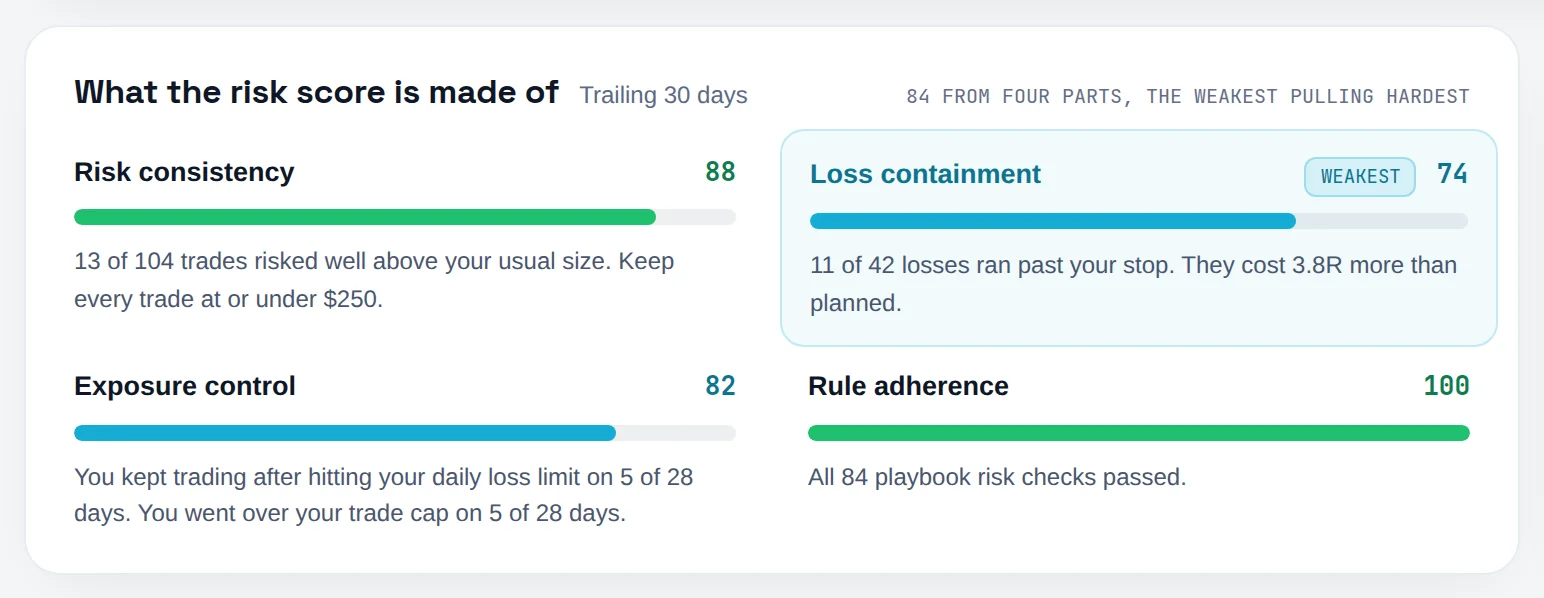
The breakdown card marks Loss Containment Weakest, because it is the one holding the number down. Fix the stops and the whole score moves. More consistent sizing would barely help.
When it shows "—"#
The ring shows "—" with the caption "Needs stops", and the read says which gate held.
| Cause | What it means |
|---|---|
| No trades in the last 30 days | Nothing to measure |
| Too little of the picture measured | The components that could be scored don't yet cover enough of the Risk Score |
Each component has its own gate:
| Component | Shows "—" when |
|---|---|
| Risk Consistency | Fewer than 8 trades with a recorded risk amount |
| Loss Containment | Fewer than 5 losing trades that had a real stop |
| Exposure Discipline | No daily loss limit and no trade cap set, or fewer than 3 trading days |
| Risk Rule Adherence | No playbook-linked trade had a risk rule that could be checked |
One light component on its own is not enough to produce a score. The more components you give Limbix to measure, the sooner a score appears and the more it can be trusted.
A "—" never costs you anything. When the Risk Score can't be measured, it sets no cap, and your Discipline Score equals your rule compliance.
What's a good risk score?#
- Reckless 0 to 50
- Fragile 50 to 70
- Loose 70 to 85
- Controlled 85 to 100
| Band | Score from | What it means |
|---|---|---|
| Controlled | 85 | Institutional risk profile. Consistent sizing, stops that hold. |
| Loose | 70 | Minor drift. Account survival is secure. |
| Fragile | 50 | Elevated variance. A standard drawdown would damage equity badly. |
| Reckless | 0 | Sizing or stop drift threatens account wipeout. |
Each band sets a cap on your Discipline Score, and every band up raises it. The band edges are deliberate goal lines, not smooth curves. The app prints the next threshold and your current cap, so you have a target, not just a verdict.
How to improve it#
- Fix the component marked Weakest. It drags the blend and holds the whole score down. See find your weakest part.
- Record a stop on every trade. Stops give Loss Containment something to measure, and give winning trades the risk amount Risk Consistency needs. See add a stop and target.
- Set a daily loss limit and a trade cap. Exposure Discipline can't be scored without one. See set your risk limits.
- Put risk rules in your playbooks. Max risk per trade, minimum R:R and max hold give Risk Rule Adherence its checks. See playbook risk parameters.
Where you'll see it#
- Discipline & Risk (
/discipline): the Risk ring labelled "Risk · 30 days", its band chip, "Caps at" caption, and the card What the risk score is made of, which shows each component and a one-line read. See read the risk ring. - Dashboard: the Risk score card. See the dashboard guide.
- NEX: reads the same stored 30-day score when you ask about your risk. See NEX.
Frequently asked questions#
What is a good risk score for a trader?#
In Limbix, 85 and above is Controlled: consistent sizing and stops that hold. Between 70 and 85 is Loose, minor drift. Below 50 is Reckless, where sizing or stop drift threatens the account. The higher your band, the less your risk holds your Discipline Score back.
Does the Risk Score look at whether my trades won?#
No. Every component measures a decision you controlled when you placed or managed the trade: how much you risked, whether the loss stopped at your stop, whether you kept trading after your loss limit, and whether you obeyed your playbook's risk rules. A winning trade with no stop still counts against sizing and stop discipline. P&L is measured elsewhere.
Why is my risk score blank when I have trades?#
Usually because too few components could be measured. Risk Consistency needs 8 trades with a recorded risk amount in the last 30 days. Loss Containment needs 5 losers that had a stop. Exposure needs a limit you set. Together, the measured ones must cover enough of the picture. The read on the page names the gate that held.
Can the Risk Score stop me from placing a trade?#
No. Limbix has read-only access to your trade history and cannot place, modify or cancel orders. The Risk Score describes how you traded over the last 30 days. It caps your Discipline Score and it names the weakest component, but nothing in Limbix blocks a trade or changes a position.
Why doesn't Limbix publish the exact weights?#
Because the method is still being validated on real traders. The weights, the pull of the weakest part and the band caps may change as Limbix calibrates them, and publishing numbers that may change would mean public corrections. Exact numbers also invite people to play to the line rather than trade well. This page explains everything that decides your score: what goes in, what's left out, and which way each part moves it.