
04 · Metrics
ROI per Firm
ProROI per firm is what each prop firm paid you, minus what you spent with it, as a share of what you spent. See which firms turn your trading into money.
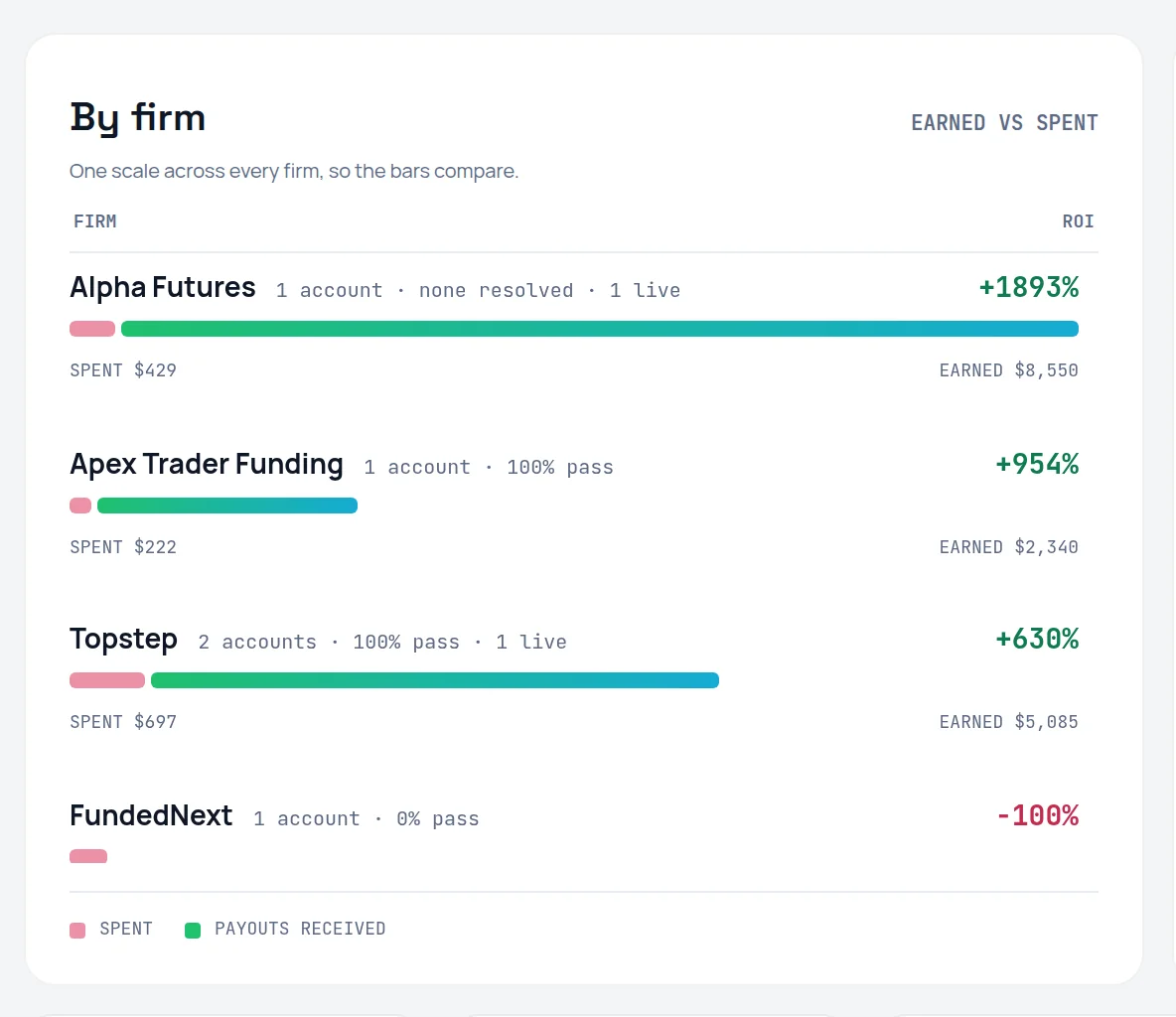
ROI per firm is the return on what you spent with each prop firm. Limbix takes the payouts you received from a firm's accounts, subtracts what you paid that firm in challenges, resets and fees, and divides by what you paid. It uses the same costs and payouts as your net prop P&L, grouped by firm.
How it's calculated#
- Earned
- Payouts marked Paid on this firm's accounts, at your share after the profit split.
- Spent
- Purchase prices plus every reset, add-on, activation fee and other cost logged on this firm's accounts.
src/lib/prop-hub.tsIt is the same arithmetic as net prop P&L, per firm and turned into a percentage. Every account counts, whatever its status: active, passed, failed, breached, paid out or archived. Requested payouts are not earned until you mark them Paid.
The firm is the one you picked when you added the account. For a custom firm, it is the name you typed.
Worked example#
You have traded with three firms.
| Firm | What you logged | Spent | Earned | ROI |
|---|---|---|---|---|
| Firm A | 3 evaluations at €150, 1 reset at €150, 1 payout of €1,500 to you | €600 | €1,500 | +150% |
| Firm B | 2 evaluations at €200, both breached | €400 | €0 | −100% |
| Firm C | 1 account you entered with no purchase price | €0 | €0 | — |
- Firm A: (€1,500 − €600) ÷ €600 × 100 = +150%
- Firm B: (€0 − €400) ÷ €400 × 100 = −100%
- Firm C: nothing spent, so there is no ROI. Limbix shows "—", not 0%.
Across all three: you spent €1,000 and received €1,500. Portfolio ROI is (€1,500 − €1,000) ÷ €1,000 = +50%. Your net prop P&L is €500.
The ROI tab ranks firms by ROI, with no-spend firms last. It names Firm A as Best firm at +150%.
When it shows "—"#
- Nothing spent with the firm. ROI divides by what you spent, so with €0 spent there is no ROI. Limbix shows "—" and ranks the firm last. A free reset, a gifted account or a missing purchase price all cause this.
- No firms yet. The By firm panel says No challenge spend recorded yet.
- Nothing spent anywhere. The ROI tab headline reads Nothing spent on challenges yet.
- Essential plan. Prop Hub is part of Pro and Ultimate. See plans.
What's a good ROI per firm?#
Limbix sets no bands. Zero is the line that matters.
| ROI | What it means |
|---|---|
| Above 0% | That firm has paid you more than you spent with it. |
| 0% | Exactly back to what you spent. |
| −100% | You spent money with that firm and nothing came back. |
| Between | Some came back, not all. |
A firm with several resolved challenges says more than a firm with one. Each row shows its account count and pass rate, and how many accounts are still live, so you can see what the ROI stands on.
If no firm is above 0%, the label changes from Best firm to Top firm by ROI. The least-bad loss is a ranking, not an achievement.
How to improve it#
ROI per firm reflects your own record with each firm. These steps make it honest and useful.
- Log every cost against the right account. A reset logged on the wrong account moves the wrong firm. See logging fees, resets and add-ons.
- Enter the purchase price when you add an account. Without it, the firm looks cheaper than it was. See adding an account.
- Mark payouts Paid when they arrive. Earned only counts Paid payouts. See logging a payout. Before you request one, the payout form checks it against your safety net.
- Read ROI with pass rate. A firm can pass you often and still lose you money. Pass rate and ROI per size show where the gap is.
Where you'll see it#
- ROI tab (
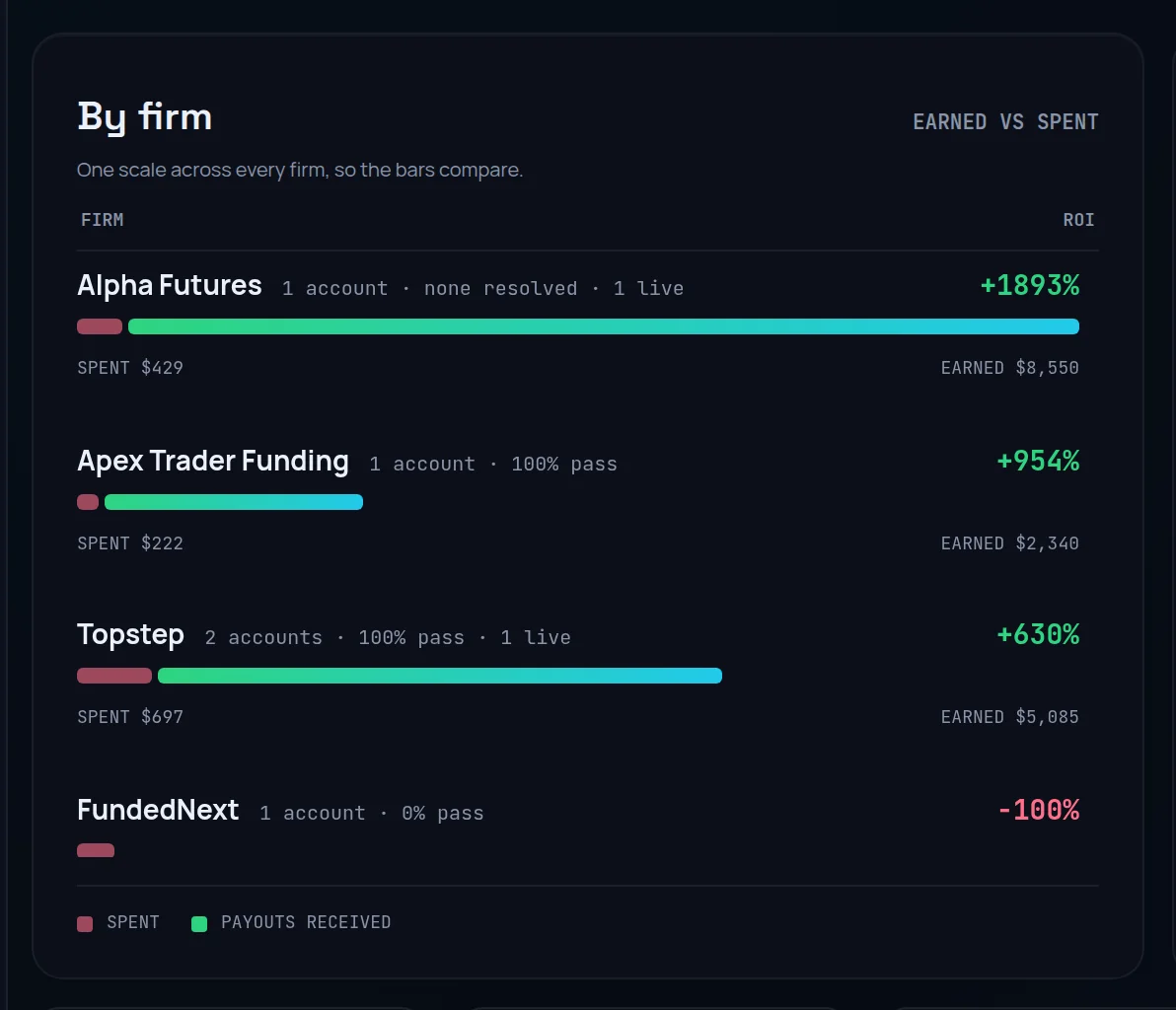
/prop/roi): headed "Which evals are worth buying". The By firm panel, captioned "Earned vs spent", shows one row per firm with account count, pass rate, live count, ROI, and the Spent and Earned figures. The lead shows Best firm. See ROI in the Prop Hub guide. - Prop Hub board (
/prop): the ROI cell in the top rail is the same formula across every firm in view.
Frequently asked questions#
How do I calculate ROI on a prop firm?#
Add up every payout the firm has actually paid you, at your share. Add up everything you paid the firm: challenge fees, resets, add-ons, activation fees. Subtract spent from earned and divide by spent. €1,500 received on €600 spent is (€1,500 − €600) ÷ €600 = +150%. Limbix does this for every firm from the costs and payouts you log.
Why does a firm show "—" instead of 0%?#
Because nothing has been spent with it. ROI divides by spend, and a percentage of zero is undefined, not 0%. Showing 0% would suggest the firm returned exactly what you paid. It also used to rank such a firm above every firm that actually lost you money. Add the purchase price to the account if you did pay for it.
Does ROI per firm include challenges I failed?#
Yes. Every account you added with that firm counts: failed, breached, passed, active, paid out and archived. A failed challenge is often the biggest cost in a firm's row. Leaving it out would make every firm look better than it has been for you.
Why is my ROI negative when I passed with this firm?#
Passing does not pay you. Only payouts marked Paid count as earned. If you passed an evaluation but have not received a payout from the funded account yet, that firm's row still holds only costs. Its ROI turns positive when paid payouts exceed everything you spent with it, failed attempts included.
Should I switch prop firms based on ROI per firm?#
ROI per firm shows how each firm has worked out for you so far. It describes what has happened, not what the next challenge will do, and Limbix doesn't recommend what to buy. Read it with the number of resolved challenges behind it: one lucky payout makes a firm look great. Rules also change, so check the firm's current rules before comparing an old result with a new challenge.